The Evolution of Mountaineering: From the Golden Age to Commercial Expeditions
By Blake Penson · January 19, 2024
Category: expedition-news
8 min read
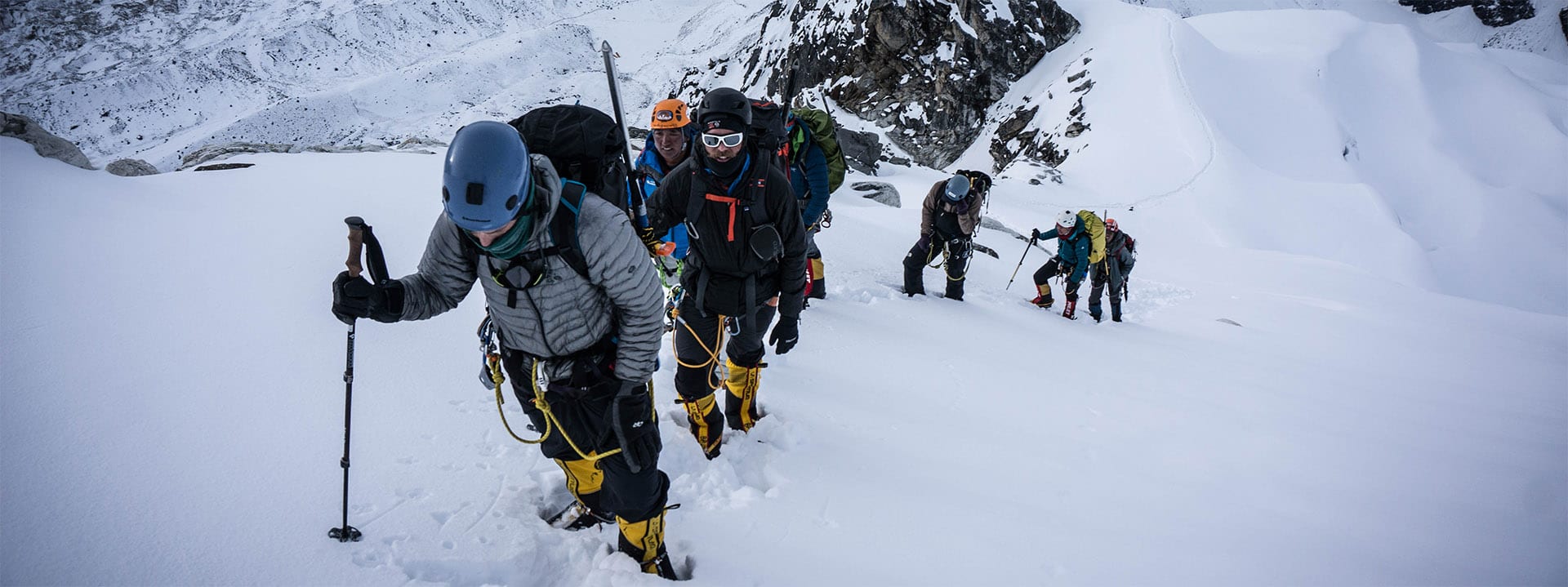
Mountaineering has changed from an elite pursuit of European explorers into a global industry. It began with landmark ascents such as Mont Blanc in 1786 and the "golden age of Alpinism" from 1854 to 1865, moved to the Himalaya with the race for the 8,000 m peaks from 1950 to 1964, and was transformed again in the 1970s and 1980s by lightweight alpine style and climbs without supplemental oxygen. Since the late 1980s, commercial guided expeditions have opened the highest peaks to paying clients, and in the last decade Nepali-owned operators and Sherpa climbers have taken the lead on many expeditions. Better gear, weather forecasts, satellite communication and helicopter rescue have made climbing more accessible, but they have not removed the risk. With more companies than ever, choosing the right guide is one of the most important decisions a climber makes. Below, we trace that evolution and what it means for you.
Milestones in the evolution of mountaineering | Year | Milestone | |---|---| | 1786 | First ascent of Mont Blanc, by Jacques Balmat and Michel-Gabriel Paccard | | 1854 | Alfred Wills climbs the Wetterhorn; often taken as the start of the golden age of Alpinism | | 1857 | The Alpine Club is founded in London | | 1865 | First ascent of the Matterhorn by Edward Whymper's party; four die on the descent | | 1950 | Annapurna, the first 8,000 m peak climbed (Maurice Herzog and Louis Lachenal) | | 1953 | Everest: Edmund Hillary and Tenzing Norgay | | 1954 | K2: Achille Compagnoni and Lino Lacedelli | | 1964 | Shishapangma, the last of the 14 8,000 m peaks to be climbed | | 1975 | Junko Tabei becomes the first woman to climb Everest | | 1978 | Reinhold Messner and Peter Habeler climb Everest without supplemental oxygen | | 1985 | Dick Bass completes the Seven Summits | | 1996 | Everest's deadliest storm of the era focuses attention on commercial climbing | | 2021 | A Nepali team makes the first winter ascent of K2 |
The birth of mountaineering in the Alps
Modern mountaineering began in the Alps. In 1786, Jacques Balmat and Michel-Gabriel Paccard made the first ascent of Mont Blanc, encouraged by a prize offered by the Geneva scientist Horace-Bénédict de Saussure. Over the next decades, climbing remained rare and was often linked to science.
That changed in the mid-1800s. Alfred Wills's ascent of the Wetterhorn in 1854 is often treated as the start of the golden age of Alpinism, when most of the major Alpine peaks were climbed for the first time, frequently by British amateurs with Swiss, French and Italian guides. The Alpine Club, the world's first mountaineering club, was founded in London in 1857. The golden age is usually said to have ended in 1865 with the first ascent of the Matterhorn by Edward Whymper's party, when four of the seven climbers died on the descent. From the beginning, local guides were central to mountaineering, and the guiding profession grew in Alpine valleys such as Chamonix, Zermatt and Grindelwald. See Mont Blanc routes and Alpine regions.
The Himalaya and the race for the 8,000 m peaks
After the First World War, attention turned to the Himalaya. British expeditions attempted Everest from Tibet in the 1920s and 1930s, including George Mallory and Andrew Irvine, who disappeared high on the mountain in 1924. After the Second World War, Nepal opened to foreign climbers, and national expeditions raced to climb the 8,000 m peaks.
In 1950, a French team led by Maurice Herzog made the first ascent of an 8,000 m peak, Annapurna. In 1953, Edmund Hillary and Tenzing Norgay reached the summit of Everest with a British expedition. K2 followed in 1954, climbed by Italians Achille Compagnoni and Lino Lacedelli, and by 1964, when a Chinese team climbed Shishapangma, all 14 of the world's 8,000 m peaks had been climbed. These were large, military-style expeditions with hundreds of porters and fixed camps. Sherpa climbers were essential from the start, though they rarely received credit at the time. See the 14 8,000 m peaks.
Alpine style and climbing without oxygen
From the 1970s, climbers challenged the expedition style. Alpine style, climbing in small teams, carrying everything and without fixed ropes or camps, moved from the Alps to the Himalaya. In 1975, Reinhold Messner and Peter Habeler climbed Gasherbrum I in alpine style. In 1978, they climbed Everest without supplemental oxygen, which many had believed impossible, and in 1980 Messner climbed Everest solo without oxygen. In 1986, he became the first person to climb all 14 8,000 m peaks.
Women were also breaking barriers. In 1975, Junko Tabei of Japan became the first woman to climb Everest. See the difference between mountaineering and alpinism.
The commercial era
In 1985, American businessman Dick Bass completed the Seven Summits, the highest mountain on each continent, with guided help on Everest. His climb showed that an amateur with money and determination could reach the highest peaks. Guided expeditions to Everest followed, offered by companies such as Rob Hall's Adventure Consultants and Scott Fischer's Mountain Madness. In May 1996, a storm high on Everest killed eight climbers, including Hall and Fischer, and the disaster, described in books including Jon Krakauer's Into Thin Air, triggered a debate about commercial climbing that continues today. See climbing the Seven Summits and the deadly obsession with Everest.
Despite the debate, commercial climbing grew. Guided climbs now operate on every major peak, from Kilimanjaro and Aconcagua to Denali, Ama Dablam and Everest. In spring 2023, Nepal issued a record 478 Everest climbing permits to foreign climbers. Queues near the summit and crowding on popular routes have led to calls for stricter rules, including proposals in Nepal to require experience on a high peak before Everest. See Everest cost.
The rise of Nepali operators and Sherpa climbers
The biggest change of the last two decades has been the rise of Nepali-owned operators. Companies based in Kathmandu now run many of the expeditions on Everest and other 8,000 m peaks, often at lower prices than Western-run companies, and Sherpa and other Nepali climbers have become leading mountaineers in their own right.
In January 2021, a team of 10 Nepali climbers made the first winter ascent of K2, the last 8,000 m peak to be climbed in winter. In 2019, Nirmal "Nims" Purja climbed all 14 8,000 m peaks in just over six months, and in 2023, Norwegian Kristin Harila and Nepali guide Tenjen Lama Sherpa climbed all 14 in 92 days. Kami Rita Sherpa has extended his record for the most Everest ascents many times. See the K2 winter 2021 summary and Kristin Harila.
This shift has given clients more choice and lower prices, but quality varies widely, from highly experienced operators to companies with less experience and fewer safety resources. See Western vs Nepali operators.
How gear and technology changed climbing
Equipment has transformed what is possible:
- Ropes: nylon ropes, widely adopted after the Second World War, replaced natural-fibre ropes, which were weaker and could snap in a fall.
- Ice tools and crampons: rigid crampons with front points and curved or drooped ice-axe picks, developed from the 1960s and 1970s, made steep ice climbing far more practical. See crampons.
- Clothing: waterproof, breathable fabrics such as Gore-Tex, introduced in the 1970s, along with synthetic and down insulation, made climbers warmer and drier.
- Boots: plastic double boots and modern integrated-gaiter boots made extreme cold more bearable. See how to choose mountaineering boots.
- Oxygen: lighter cylinders and better regulators have made supplemental oxygen more reliable on 8,000 m peaks.
- Forecasting: detailed mountain weather forecasts now help teams pick summit windows.
- Communication: satellite messengers and phones allow climbers to call for help and receive forecasts from remote mountains.
- Rescue: helicopter rescue is now common in Nepal and the Alps, though it remains limited by altitude and weather.
Guiding becomes a profession
As climbing spread, so did professional standards for guides. Alpine guide associations developed in the 19th and early 20th centuries in the main valleys, and in 1965 guide associations from France, Switzerland, Austria and Italy founded the International Federation of Mountain Guides Associations (IFMGA). It set common international standards for training and assessment, and IFMGA certification is now held by guides in many countries, including Nepal, which joined through the Nepal National Mountain Guide Association. On high-altitude expeditions, though, many guides and Sherpas still learn mainly through experience rather than formal certification, which is why checking an operator's staff and track record matters.
Women in mountaineering
Women have climbed since the early days, often against social barriers. After Junko Tabei's Everest ascent in 1975, Poland's Wanda Rutkiewicz became the first woman to climb K2, in 1986. Pasang Lhamu Sherpa became the first Nepali woman to climb Everest in 1993 but died on the descent. Edurne Pasaban, in 2010, and Gerlinde Kaltenbrunner, in 2011, became the first women to climb all 14 8,000 m peaks, Kaltenbrunner without supplemental oxygen. Today, more women work as guides and expedition leaders, including Nepali women guides.
How climbers find information
For most of mountaineering's history, climbers relied on guidebooks, club journals and word of mouth. The internet changed that. Expedition blogs, forums and social media now report conditions and summits in real time, and operators market themselves online with photos and claims that are hard to check. That makes independent information more valuable: published permit data, research such as the Himalayan Database, accident reports and reviews from past clients all help climbers judge an operator beyond its marketing.
Rules and regulation
Governments have also become more involved. Nepal raised its spring Everest climbing royalty for foreigners from US$11,000 to US$15,000 from September 2025, and it regularly debates rules on experience, waste, rescue and liaison officers. Local authorities in the Alps have closed routes or huts in dangerous conditions. Expect regulation to continue to evolve, and check current rules before you book.
New ways to climb
The evolution continues. Some operators now offer "flash" expeditions in which clients pre-acclimatise at home in hypoxic tents, shortening the time on the mountain. Speed records and enchainments of several peaks have pushed the limits of what is possible. On the other hand, there is growing interest in less-crowded peaks, in climbing with smaller teams and in responsible climbing that reduces waste and supports local workers. See responsible climbing on Everest.
What hasn't changed
Despite the gear and the guides, the mountains remain dangerous. Avalanches, icefall collapses, storms, altitude illness and human error still kill climbers every year. Experience, judgement and preparation remain essential, and no operator can make a high mountain safe. See the death zone. The risks also fall heavily on the people who make commercial climbing possible. On 18 April 2014, an ice avalanche in the Khumbu Icefall killed 16 Nepali mountain workers who were carrying loads and fixing the route, the deadliest single accident on Everest at that time. It led to protests, the cancellation of most of that season's climbs and lasting debate about insurance, pay and conditions for Sherpas and other high-altitude workers. When you choose an operator, its treatment of staff is part of its safety record.
Choosing a guide in today's market
With more operators than ever, how do you choose? Focus on:
- Experience on the specific mountain, with a track record of safe expeditions.
- Guide qualifications, such as IFMGA certification in the Alps. See IFMGA guides.
- Guide-to-client and Sherpa-to-client ratios.
- Oxygen, rescue and safety plans, including what happens if you need to descend.
- Fair treatment of staff, including pay, insurance and equipment for Sherpas and porters.
- What the price includes, so you can compare offers fairly.
- Verified reviews from past clients.
ExpedReview publishes verified client reviews of guiding companies, so you can see how operators performed for climbers like you. See how to choose an Everest operator.
What it means for climbers today
For a climber starting out today, the evolution of mountaineering is mostly good news. Training, information, gear and guided options are better than ever, and peaks that once needed national expeditions can be climbed in a few weeks. The flip side is that it is easier to reach a mountain before you are ready for it. Build experience step by step, from skills courses to glaciated peaks to higher objectives, and choose your team as carefully as your mountain.
Frequently asked questions
When did mountaineering begin?
Modern mountaineering is usually traced to the first ascent of Mont Blanc in 1786 and the golden age of Alpinism from 1854 to 1865.
What was the golden age of Alpinism?
The period from 1854 to 1865, when most major Alpine peaks were first climbed. It ended with the first ascent of the Matterhorn in 1865.
When were commercial expeditions to Everest first offered?
Guided expeditions to Everest grew in the late 1980s and early 1990s, after Dick Bass completed the Seven Summits in 1985.
What is alpine style?
Climbing in small, self-sufficient teams without fixed ropes, fixed camps or large support teams.
How has mountaineering changed in the last decade?
Nepali operators now lead many expeditions, more people are climbing, and new technology has improved forecasting, communication and rescue.
How do I choose a mountaineering guide?
Look at experience, qualifications, ratios, safety plans, staff treatment, inclusions and verified client reviews.
Tags: mountaineering-industry, guiding-companies, trends-2024, demographics, adventure-tourism