Huayhuash Circuit Trek: Route, Itinerary, Altitude, Best Time and Huayhuash vs Santa Cruz
By Blake Penson · July 23, 2024
Category: destination-guides
8 min read
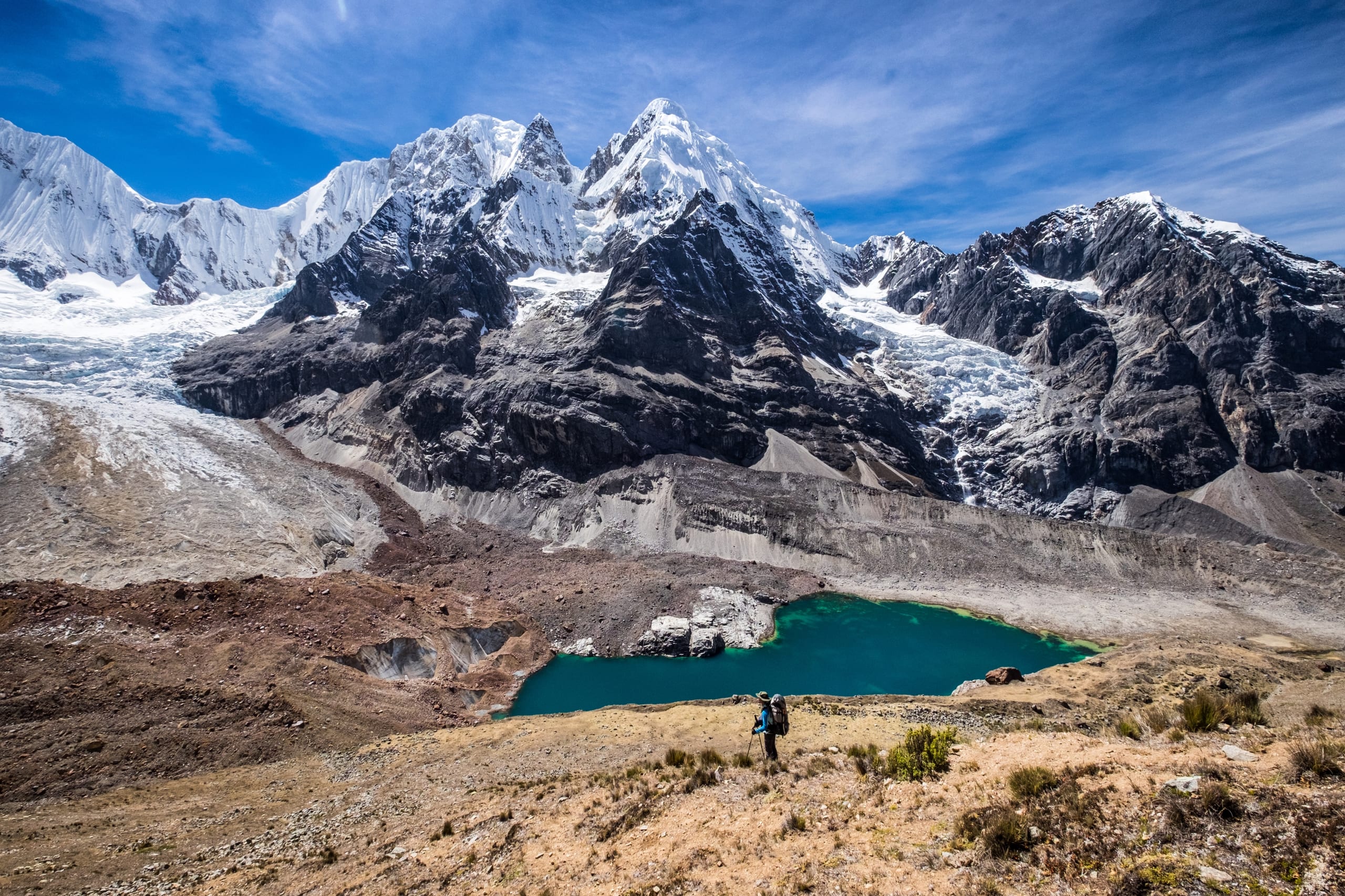
The Huayhuash Circuit is a high-altitude trek around the Cordillera Huayhuash in Peru's central Andes, south of the Cordillera Blanca and reached from the mountain town of Huaraz. The full circuit usually takes 8 to 12 days and covers roughly 100–130 km, depending on the variant, crossing around eight high passes between about 4,600 m and 5,000 m and camping beside turquoise glacial lakes beneath peaks such as Yerupajá, Peru's second-highest mountain, and Siula Grande, made famous by Joe Simpson's "Touching the Void". It is widely considered one of the world's best treks. It is strenuous because almost all of it is above 4,000 m, so acclimatise in Huaraz (about 3,050 m) for several days first. The best time to go is the dry season, roughly May to September. Compared with the Santa Cruz trek, Huayhuash is longer, higher, more remote and harder; Santa Cruz is a shorter, easier introduction of about four days in the Cordillera Blanca. Local communities along the route charge fees for access and camping, so carry cash in Peruvian soles. See ExpedReview's Peru and Bolivia page for climbing in the region.
| Fact | Detail |
|---|---|
| Location | Cordillera Huayhuash, central Peru |
| Base town | Huaraz (~3,050 m) |
| Duration | 8–12 days (full circuit); shorter variants possible |
| Distance | Roughly 100–130 km depending on route |
| High passes | About eight, roughly 4,600–5,000 m |
| Highest peak in range | Yerupajá (~6,635 m), Peru's second highest |
| Best season | Dry season, about May to September |
| Fees | Community fees paid along the route (cash) |
| Difficulty | Strenuous; high altitude throughout |
Where is the Huayhuash?
The Cordillera Huayhuash is a compact range of the Peruvian Andes, about 30 km long, lying south of the much larger Cordillera Blanca. Despite its small size, it contains several peaks over 6,000 m, including Yerupajá, Siula Grande, Sarapo and Jirishanca. The range is known for its sharp, heavily glaciated summits and a string of beautiful lakes.
Most trekkers base themselves in Huaraz, the hub for trekking and climbing in the Cordillera Blanca and Huayhuash. From Huaraz, a road journey of several hours leads via Chiquián to the trailheads near Llamac or Quartelhuain.
Why trek the Huayhuash Circuit?
- Spectacular scenery: jagged, ice-covered peaks, glaciers and turquoise lakes almost every day.
- Remoteness: fewer trekkers than many famous treks, and few roads.
- Culture: small Andean communities and herders along the route.
- Altitude challenge: high passes every day or two, with views that reward the effort.
- Mountaineering history: Siula Grande and the story of Joe Simpson and Simon Yates.
Huayhuash Circuit itinerary
There are many variants, but a typical 10-day itinerary looks like this:
| Day | Route |
|---|---|
| 1 | Huaraz to Quartelhuain or Llamac trailhead; camp |
| 2 | Cross the first passes to Laguna Mitucocha or Jahuacocha area |
| 3 | Pass to Laguna Carhuacocha, with views of Yerupajá and Siula Grande |
| 4 | Three Lakes viewpoint and pass to Huayhuash camp |
| 5 | Pass to Laguna Viconga; hot springs nearby |
| 6 | Cross Punta Cuyoc, one of the highest passes, to Huanacpatay |
| 7 | Huanacpatay to Huayllapa |
| 8 | Pass to the Gashpapampa area |
| 9 | Pass to Jahuacocha, beneath Rondoy and Jirishanca |
| 10 | Descend to Llamac and drive back to Huaraz |
Some trekkers add a side trip toward the Siula Grande base camp area or the San Antonio pass, with famous views of Siula Grande and the lakes below. Others shorten the trek by starting or finishing at different points.
How hard is the Huayhuash Circuit?
The Huayhuash Circuit is a challenging trek, mainly because of altitude. Most nights are spent above 4,000 m, and many passes are near 5,000 m. Days often involve 600–1,000 m of ascent and descent on rough trails. The trek is non-technical, so you will not need ropes, crampons or climbing skills in normal conditions, but you will need good fitness and acclimatisation.
Weather can change quickly, with cold nights below freezing, strong sun, and occasional snow on the passes, even in the dry season.
When to go
The best time to trek the Huayhuash is during the dry season, roughly May to September. June to August usually brings the most stable weather, with clear skies and cold nights. The wet season, from about December to March, brings rain, snow on the passes and muddy trails, and many services close.
Acclimatisation
Acclimatisation is essential. Spend at least three to five days in and around Huaraz before starting the trek. Good acclimatisation day hikes include Laguna Churup and Laguna 69 in the Cordillera Blanca. Watch for symptoms of acute mountain sickness and descend if they get worse.
Community fees
The communities along the Huayhuash Circuit manage access to their land and charge fees to trekkers at various points, in exchange for maintaining campsites and, in some areas, providing security. Fees vary and change over time, so carry enough cash in small Peruvian soles for the whole trek. Organised trips usually include these fees; check what your price includes.
Guided or independent?
The Huayhuash can be trekked independently by experienced, self-sufficient trekkers, but most people join an organised trek. Typical organised treks include:
- An arriero (muleteer) and donkeys or mules to carry gear.
- A cook and camp staff.
- A trekking guide who knows the routes and passes.
- Tents, food and community fees.
Organised treks make the circuit much more comfortable and safer, especially in bad weather or if someone gets sick.
Highlights of the circuit
Laguna Carhuacocha. For many trekkers, this is the most memorable campsite on the circuit. At dawn, Yerupajá and Siula Grande can be reflected in the lake, with glaciers tumbling toward the water. It is worth getting up early for the light.
The Three Lakes viewpoint. Above Carhuacocha, a climb leads to a viewpoint over three glacial lakes, Siula, Quesillacocha and Gangrajanca, set beneath the ice of the main peaks. It is one of the classic views of the Andes.
Laguna Jahuacocha. Near the end of many itineraries, this lake sits beneath the dramatic north faces of Rondoy, Jirishanca and Yerupajá. Many trekkers spend an extra night here.
Viconga hot springs. Hot pools near Laguna Viconga are a welcome break halfway around the circuit.
The high passes. Each pass brings a new view: icy peaks, colourful mineral-stained hillsides and long valleys. On clear days, views stretch over the Cordillera Blanca.
Fitness and training
You do not need climbing skills for the Huayhuash, but you need good hiking fitness and the ability to walk for six to eight hours a day at high altitude, day after day. Before the trek:
- Hike regularly on hilly terrain, building up to back-to-back long days.
- Train with a day pack of 6–8 kg, or heavier if you plan to carry your own gear.
- Add stair climbing, cycling or running for aerobic fitness.
- Strengthen your legs and core to handle steep descents on rough ground.
If you have time, include a multi-day hike in your training to test your gear and feet. See training for mountaineering adventures.
Safety
The Huayhuash is remote, and evacuation can take time. Keep these points in mind:
- Altitude: Acclimatise properly and descend if symptoms of altitude sickness worsen.
- Weather: Snow, hail and strong wind can hit the passes, especially in the afternoon. Start early.
- Water: Treat all water. Livestock graze in many valleys.
- Communication: Mobile coverage is limited. Organised groups often carry satellite devices.
- Insurance: Make sure your travel insurance covers trekking at these altitudes and helicopter evacuation.
Travel with a reputable local operator and check recent conditions before you go.
Leave no trace
The Huayhuash's beauty depends on respectful visitors. Carry out all rubbish, use designated campsites and toilets where available, and avoid washing with soap in lakes and streams. Respect private land and livestock, and ask before taking photos of local people. Community fees support local people and help keep the circuit open to trekkers.
Getting to Huaraz
Most visitors reach Huaraz by bus from Lima, a journey of about eight hours on comfortable overnight or day buses. Huaraz has hotels, restaurants, gear rental shops and many trekking agencies. It is also a great base for acclimatisation hikes and climbing in the Cordillera Blanca.
Huayhuash vs Santa Cruz
| Huayhuash Circuit | Santa Cruz trek | |
|---|---|---|
| Range | Cordillera Huayhuash | Cordillera Blanca |
| Duration | 8–12 days | About 4 days |
| Highest point | Around 5,000 m | Punta Unión pass, ~4,750 m |
| Difficulty | Strenuous | Moderate |
| Crowds | Quieter | Busier |
| Best for | Experienced trekkers seeking a big adventure | First high-altitude trek, shorter trips |
If you have limited time or are new to high-altitude trekking, the Santa Cruz trek is a great introduction. If you want one of the world's great treks and have the time and fitness, choose the Huayhuash. Many trekkers do Santa Cruz as acclimatisation before the Huayhuash.
A typical day on the trek
Most days start early. On organised treks, camp staff bring hot drinks to your tent around dawn, followed by breakfast while the arrieros load the donkeys. You set off on foot with a day pack, carrying water, snacks, warm layers and rain gear, while the animals take the main loads and often overtake you on the trail.
The morning is usually spent climbing toward a pass, taking it slowly and steadily in the thin air. After a rest and photos at the top, the trail descends into a new valley, often past lakes and grazing land. Many groups reach camp in the early afternoon, before the weather tends to change. Afternoons are for resting, washing, exploring near camp and acclimatising. Dinner is served early in a dining tent, and nights are cold and starry.
Who is the Huayhuash Circuit for?
The circuit suits fit, experienced hikers who are comfortable with long days, basic camping and cold nights, and who want a remote adventure. It is a great choice for trekkers who have done treks such as the Everest Base Camp trek or the Annapurna Circuit and want something wilder. It is also popular with climbers acclimatising for peaks in the Cordillera Blanca. If you are new to high-altitude trekking, start with a shorter trek such as Santa Cruz.
What to pack
- Warm sleeping bag rated to about -10°C or colder.
- Down jacket and warm layers.
- Waterproof jacket and trousers.
- Sturdy, broken-in trekking boots.
- Trekking poles.
- Sun hat, sunglasses and strong sunscreen.
- Water purification.
- Cash for community fees.
- Personal first aid kit, including blister care and altitude medication if prescribed.
Touching the Void and Siula Grande
The Huayhuash is famous among climbers because of Joe Simpson and Simon Yates's 1985 first ascent of the west face of Siula Grande. On the descent, Simpson broke his leg. While lowering him, Yates was being pulled off the mountain and eventually cut the rope, and Simpson fell into a crevasse. Yates returned to camp believing his partner was dead. Simpson crawled back to base camp over several days. His book, "Touching the Void", and the later film made the story world famous. Many trekkers visit the area near the Siula Grande base camp as part of the circuit.
Climbing in the Huayhuash and Cordillera Blanca
For mountaineers, the Huayhuash and nearby Cordillera Blanca offer many classic climbs. Peaks such as Alpamayo, often described as one of the most beautiful mountains in the world, and trekking peaks such as Pisco and Vallunaraju are popular. Huaraz has many guiding companies and gear shops.
Frequently asked questions
How long is the Huayhuash Circuit?
The full circuit usually takes 8 to 12 days and covers roughly 100–130 km, depending on the route.
How hard is the Huayhuash trek?
It is strenuous, mainly because of altitude. Most nights are above 4,000 m and many passes are near 5,000 m.
Huayhuash or Santa Cruz: which is better?
Huayhuash is longer, higher and more remote; Santa Cruz is shorter and easier. Choose Santa Cruz for a first high-altitude trek and Huayhuash for a bigger adventure.
When is the best time to trek the Huayhuash Circuit?
The dry season, roughly May to September, with June to August usually best.
What is the altitude of the Huayhuash trek?
Most of the trek is above 4,000 m, and the highest passes are around 5,000 m.
Do you need a guide for the Huayhuash?
Not legally required in all cases, but most trekkers join an organised trek with an arriero, cook and guide.
Where does the Huayhuash Circuit start?
Most treks start from Huaraz, with a drive via Chiquián to the trailheads near Llamac or Quartelhuain.
Is the Huayhuash Circuit safe?
It is a remote, high-altitude trek, so the main risks are altitude illness and weather. Organised treks and good acclimatisation reduce the risk.
Can you do the Huayhuash Circuit in fewer days?
Yes. Shorter variants of about five to seven days cover part of the circuit, including highlights such as Carhuacocha and the Three Lakes viewpoint.
What is the highest pass on the Huayhuash Circuit?
The highest passes on common variants are around 5,000 m, including Punta Cuyoc and the San Antonio pass.
How do you get to the Huayhuash from Lima?
Take a bus from Lima to Huaraz, then a road transfer via Chiquián to the trailhead.
Is the Huayhuash Circuit worth it?
For fit, well-acclimatised trekkers, yes. Many people who have trekked widely rank it among the most spectacular treks in the world, with big glaciated peaks and lakes almost every day.
Tags: huayhuash, peru, trekking, andes, siula-grande