Kristin Harila: 14 Peaks in 92 Days, Records, Controversy & 2026 Triple Crown
By Blake Penson · August 20, 2026
Category: climber-profiles
5 min read
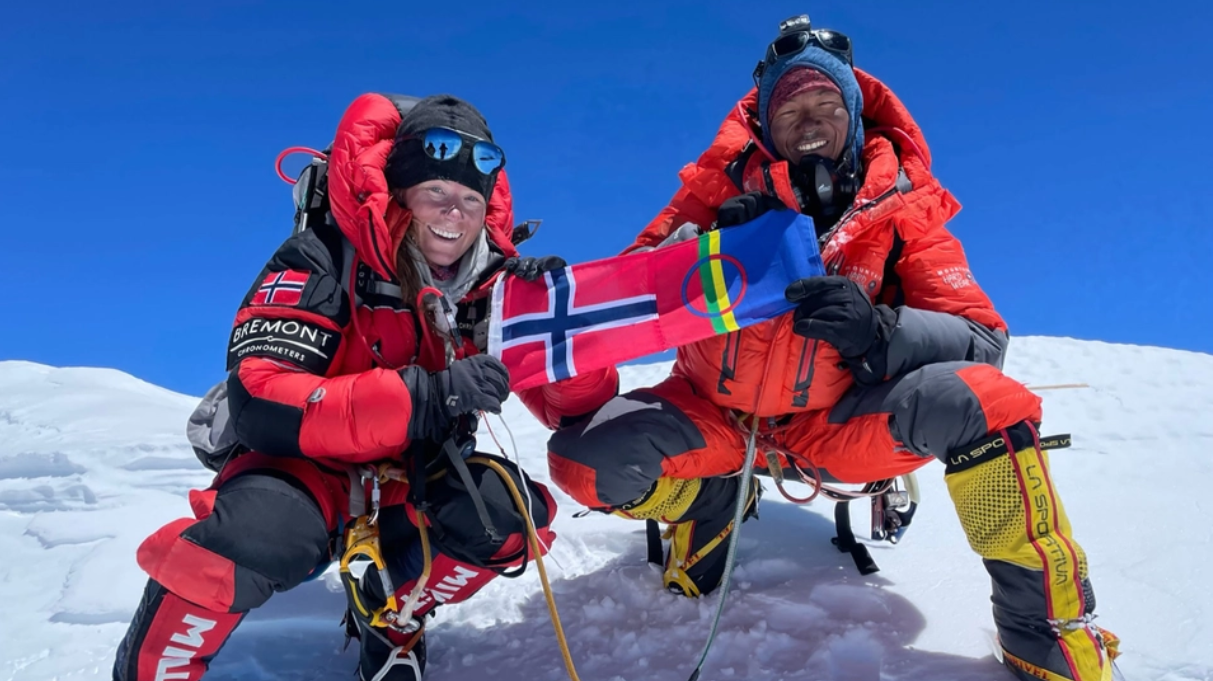
Kristin Harila is a Norwegian mountaineer who, with Nepali guide Tenjen "Lama" Sherpa, climbed all 14 of the world's 8,000-metre peaks in 92 days. They began on Shishapangma on 26 April 2023 and finished on K2 on 27 July 2023. That is the fastest time anyone has climbed the 14 highest peaks, and Guinness World Records lists it as the fastest "true-summit" ascent of the eight-thousanders. It cut the previous record of about six months, set by Nirmal "Nims" Purja in 2019, by roughly half. Harila was not the first woman to climb all 14 peaks. Spain's Edurne Pasaban is usually credited with that in 2010, and China's Dong Hongjuan finished a verified true-summit set a week before Harila in 2023. What Harila holds is the speed record for any climber, male or female. In May 2026 she added another first: the Everest "Triple Crown" of Nuptse, Lhotse and Everest in one season, with Everest climbed without supplemental oxygen.
This profile covers who Kristin Harila is, the full 2023 timeline with dates and heights, how her record compares with Nims Purja and the rest of the 14-peak history, the controversies, the death of Tenjen Lama Sherpa, and what she has done since.
Kristin Harila at a glance - Nationality: Norwegian - Background: former cross-country skier and corporate executive; started mountaineering in the mid-2010s - Record: all 14 eight-thousanders in 92 days (26 Apr – 27 Jul 2023), with Tenjen Lama Sherpa - Earlier record: all 14 in 1 year and 5 days, completed on Cho Oyu on 3 May 2023 - Previous record holder: Nirmal "Nims" Purja, about 6 months and 6 days (2019) - Supplemental oxygen: used on most 2023 peaks; Gasherbrum I climbed without it - 2026: Nuptse (17 May), Lhotse (21 May) and Everest without O₂ (27 May), the first woman to do the Everest Triple Crown in one season
Who is Kristin Harila?
Harila grew up in Norway and competed as a cross-country skier, a sport that builds the aerobic engine high-altitude climbing needs. She later worked as a sales and marketing executive in the furniture industry. Her move into mountaineering is often traced to a trip up Kilimanjaro in the mid-2010s, where she suffered badly from the altitude and still came home wanting more.
By 2019 she had left her corporate job to climb full time. Over the next few years she built Himalayan experience on peaks such as Lobuche East (6,119 m) and Putha Hiunchuli (7,246 m), climbed Aconcagua (6,961 m), and then moved on to the 8,000-metre peaks. Her early climbs included Everest and Lhotse in a single push, a combination many 8,000 m climbers use because the routes share most of their length up to the Lhotse Face.
What set her apart was not a long climbing CV. It was a willingness to treat the 14 peaks as one tightly planned logistical project: pre-booked helicopters, rotating Sherpa teams, and pushing straight from one peak to the next with almost no rest. That style is also what drew most of the criticism.
The 2022 attempt: blocked by China
Harila's first attempt at a 14-peak speed record began in spring 2022, when she set out to climb all of them within six months. The project went well in Nepal and Pakistan. She climbed 12 of the 14 in 2022. But the two peaks entirely or partly in Tibet, Shishapangma and Cho Oyu from its Tibetan side, could not be climbed. China kept its mountains closed to most foreign climbers that year under its COVID-era rules, and Harila's applications for a permit were refused.
She finished the set the following spring, completing all 14 when she summited Cho Oyu on 3 May 2023. Guinness World Records recognised that as the fastest ascent of all 14 eight-thousanders at the time: 1 year and 5 days. By then she had already started a second, far faster project.
The 2023 record: all 14 peaks in 92 days
In spring 2023 China reopened Tibet. Harila decided to restart from scratch and try to climb all 14 within a single season. Her climbing partner for every peak was Tenjen "Lama" Sherpa, an experienced Nepali high-altitude guide. Logistics were run by the Kathmandu-based operator Seven Summit Treks.
Kristin Harila's 14 peaks: dates and heights
| # | Peak | Height (m) | Height (ft) | Country | Summit date (2023) | World rank |
|---|---|---|---|---|---|---|
| 1 | Shishapangma | 8,027 | 26,335 | China (Tibet) | 26 April | 14 |
| 2 | Cho Oyu | 8,188 | 26,864 | Nepal / China | 3 May | 6 |
| 3 | Makalu | 8,485 | 27,838 | Nepal / China | 13 May | 5 |
| 4 | Kangchenjunga | 8,586 | 28,169 | Nepal / India | 18 May | 3 |
| 5 | Everest | 8,849 | 29,032 | Nepal / China | 23 May | 1 |
| 6 | Lhotse | 8,516 | 27,940 | Nepal / China | 23 May | 4 |
| 7 | Dhaulagiri I | 8,167 | 26,795 | Nepal | 29 May | 7 |
| 8 | Annapurna I | 8,091 | 26,545 | Nepal | 5 June | 10 |
| 9 | Manaslu | 8,163 | 26,781 | Nepal | 10 June | 8 |
| 10 | Nanga Parbat | 8,126 | 26,660 | Pakistan | 26 June | 9 |
| 11 | Gasherbrum II | 8,035 | 26,362 | Pakistan / China | 15 July | 13 |
| 12 | Gasherbrum I | 8,080 | 26,509 | Pakistan / China | 18 July | 11 |
| 13 | Broad Peak | 8,051 | 26,414 | Pakistan / China | 23 July | 12 |
| 14 | K2 | 8,611 | 28,251 | Pakistan / China | 27 July | 2 |
Dates as published by Harila's team and the expedition operator. The 92-day total is the figure recognised by Guinness World Records.
The three phases of the record
Phase 1: Tibet (late April to early May). The pair started with the two Tibetan peaks. Shishapangma is the lowest of the 14 but has a notoriously tricky summit ridge. Many past "summits" stopped at the central summit rather than the true main summit. Cho Oyu, often called the most accessible 8,000er, came a week later.
Phase 2: Nepal (May to early June). Seven Nepali peaks followed in just over a month. Makalu and Kangchenjunga came first. Then Everest and Lhotse were climbed on the same day, 23 May, after which the pair flew west for Dhaulagiri, Annapurna and finally Manaslu. Helicopter transfers between base camps cut out weeks of trekking. The monsoon also arrives in June, so speed mattered.
Phase 3: Pakistan (late June to late July). After Nanga Parbat in late June, the team moved to the Baltoro Glacier area of the Karakoram for the Gasherbrums, Broad Peak and finally K2. Bad weather in the Karakoram held them up for weeks. Then a short window in late July let them climb GII, GI and Broad Peak in quick succession and top out on K2 on 27 July.
Did Kristin Harila use oxygen?
Yes, on most peaks. Harila and Tenjen used supplemental oxygen and fixed ropes, and relied on Sherpa support teams and established high camps, as most commercial 8,000 m climbers do. Harila has said they climbed Gasherbrum I without supplemental oxygen and used only limited oxygen, sometimes a single bottle, on several other peaks. The style was the standard "expedition style" of commercial Himalayan climbing, not "alpine style" (see our explainer on the difference between mountaineering and alpinism). That is why many in the climbing world see the record as an achievement of logistics and endurance rather than pure alpinism.
Who climbed all 14 peaks the fastest?
Kristin Harila and Tenjen Lama Sherpa, in 92 days, in 2023. That is the fastest recognised time to climb all 14 eight-thousanders. Guinness lists it both as the fastest ascent of the 14 by a woman and as the fastest true-summit ascent overall. Tenjen took the men's record at the same moment, because he climbed every peak alongside her.
How the 14-peak speed record has fallen
| Year completed | Climber(s) | Time to climb all 14 | Notes |
|---|---|---|---|
| 1986 | Reinhold Messner (Italy) | ~16 years (1970–1986) | First person to climb all 14; all without supplemental oxygen |
| 1987 | Jerzy Kukuczka (Poland) | ~7 years 11 months | Second person; many new routes and winter ascents |
| 2013 | Kim Chang-ho (South Korea) | ~7 years 10 months | Fastest at the time without supplemental oxygen |
| 2019 | Nirmal "Nims" Purja (Nepal/UK) | ~6 months 6 days | "Project Possible"; later re-climbed Manaslu to confirm the true summit |
| 2023 (May) | Kristin Harila (Norway) | 1 year 5 days | Completed on Cho Oyu, 3 May 2023 |
| 2023 (July) | Kristin Harila & Tenjen Lama Sherpa | 92 days | Current record |
Earlier claimed times have been revised by research into "true summits". Several historic ascents of Manaslu, Dhaulagiri, Annapurna and Shishapangma are now thought to have stopped short of the highest point.
Was Kristin Harila the first woman to climb all 14 peaks?
No. This is the most common error made about her, and earlier versions of many articles, including this one, got it wrong.
- Edurne Pasaban (Spain) is widely recognised as the first woman to climb all 14 eight-thousanders, finishing on Shishapangma in May 2010.
- Oh Eun-sun (South Korea) claimed the title a few weeks earlier, in April 2010, but her Kangchenjunga summit was disputed, and many record-keepers do not accept it.
- Under the stricter true-summit standard developed by researchers such as Eberhard Jurgalski and the team at 8000ers.com, Dong Hongjuan (China) was the first woman to finish a verified set, on 26 April 2023, about a week before Harila completed hers on Cho Oyu.
Harila was therefore the second woman to complete a verified true-summit set of all 14, and she remains the fastest person of any gender to do it.
Kristin Harila vs Nims Purja
Many people search "Nims Dai" together with Harila's name. That makes sense: Harila's project was openly modelled on Nirmal Purja's "Project Possible".
| Nirmal "Nims" Purja | Kristin Harila & Tenjen Lama Sherpa | |
|---|---|---|
| Year | 2019 | 2023 |
| Total time | ~6 months 6 days (189 days) | 92 days |
| First peak | Annapurna I (23 Apr 2019) | Shishapangma (26 Apr 2023) |
| Last peak | Shishapangma (29 Oct 2019) | K2 (27 Jul 2023) |
| Supplemental oxygen | Yes, on most peaks | Yes, on most peaks (GI without) |
| Helicopters between base camps | Yes | Yes |
| Documentary | 14 Peaks: Nothing Is Impossible (Netflix, 2021) | — |
| True-summit questions | Manaslu re-climbed in 2021 to confirm | Recognised by Guinness as true-summit |
Purja, a former Gurkha and UK Special Boat Service soldier, went on to lead the Nepali team that made the first winter ascent of K2 on 16 January 2021, and founded the expedition company Elite Exped. His 2019 project changed what people thought was possible in the 8,000 m world. Harila's record built directly on the same model of fast, well-funded, heavily supported climbing, now with China reopened and a more mature commercial support network.
The controversies
Harila's record drew praise and fierce criticism, often at the same time.
Helicopters, oxygen and "style"
Critics argued that helicopter transfers between base camps, heavy use of bottled oxygen, fixed ropes laid by other teams and large support crews made the record more about money and logistics than mountaineering. Harila's response was that she never claimed an alpine-style record. The challenge was to climb all 14 safely and quickly within the rules most commercial climbers follow, and every summit was a true summit.
K2 and the death of Muhammad Hassan
The most serious controversy came on K2 on 27 July 2023, the day the record was completed. A Pakistani high-altitude porter, Muhammad Hassan, fell at the Bottleneck at about 8,200 m and later died. Dozens of climbers, including Harila's team, passed him on their way up and down. Drone footage shared online led to accusations that climbers had put the summit before trying to save a life. Harila said her team had spent time trying to help him in a dangerous spot and that the footage did not show the full picture. Pakistani authorities opened an inquiry. The incident set off a wider debate about the safety, pay and equipment of Pakistani high-altitude workers, and about crowding on K2.
What the critics and supporters agree on
Most commentators agree on three things: the physical and logistical scale of the 92-day project was extraordinary; Sherpa and Pakistani support workers carried much of the risk; and the record reflected how commercial 8,000 m climbing has changed. It is now a world of helicopters, drones, satellite weather forecasts and large Nepali-run operators.
The death of Tenjen Lama Sherpa
Tenjen "Lama" Sherpa was central to the record. He climbed every one of the 14 peaks alongside Harila, broke trail, made safety calls and shared the Guinness record. On 7 October 2023, just over two months after K2, he was killed in an avalanche on Shishapangma, guiding American climber Gina Marie Rzucidlo, who was also trying to become the first American woman to climb all 14. Rzucidlo died too. A second avalanche the same day killed American Anna Gutu and her guide Mingmar Sherpa.
Harila has spoken publicly about how hard his death hit her. She has supported the education of his children and returned to Tibet to search for his body. A 2024 search was unsuccessful, and in 2025 she was unable to obtain a Chinese visa to return.
Kristin Harila's Everest Triple Crown (2026)
In spring 2026 Harila returned to the Khumbu with a goal she described as a farewell to Everest: the Everest Triple Crown of Nuptse, Lhotse and Everest in a single season. She climbed with Ming Temba Sherpa.
| Peak | Height | Summit date (2026) | Oxygen |
|---|---|---|---|
| Nuptse | 7,861 m | 17 May | Without supplemental oxygen |
| Lhotse | 8,516 m | 21 May | Supplemental oxygen used high on the climb because of strong wind |
| Everest | 8,849 m | 27 May | Without supplemental oxygen |
By her team's account, this made her the first woman to complete the Everest Triple Crown in one season, and the first Norwegian to summit Everest without supplemental oxygen. The Lhotse summit was her 30th ascent of an 8,000-metre peak. She climbed during a record season on Everest: Nepal's Department of Tourism reported 1,008 summits in spring 2026 (see our Everest 2026 season review).
Harila's record in context
Speed records on the 8,000 m peaks are a fairly new thing. For most of the twentieth century, the 14 peaks were seen as a lifetime project. Messner took 16 years. Kukuczka, racing him, took nearly eight. Through the 1990s and 2000s, finishing in under ten years was a big achievement. Commercial guiding, helicopter access, better forecasting and Nepali-run operators with large Sherpa teams changed that in the 2010s. Nims Purja's 2019 project showed that a well-funded team could climb all 14 in a single year. Harila showed that, with Tibet open and perfect logistics, it could be done in a single season.
Each jump in speed has brought the same arguments: whether bottled oxygen, helicopters and fixed ropes make the achievement less, whether speed records push climbers to take risks, and how much credit belongs to the Sherpa and Pakistani climbers who carry the heaviest loads. These arguments are not new. Messner's no-oxygen ascents in the 1970s set off similar debates. But social media now magnifies them, as Harila's experience on K2 showed.
How the 92-day record was planned
Speed projects on the 8,000 m peaks are won or lost off the mountain. Harila's team had to solve several problems at once.
Permits across three countries
Each country issues its own climbing permits. Nepal issues them through the Department of Tourism, China through the China Tibet Mountaineering Association, and Pakistan through the Gilgit-Baltistan authorities and the Alpine Club of Pakistan. A 14-peak season means applying for 14 separate permits, paying 14 sets of royalties, and timing every one so it is valid when the team arrives. In 2022 a single refusal, China's, was enough to break the project.
Moving between base camps
On foot, the approach treks alone would take months. Kangchenjunga base camp is several days' walk from the nearest airstrip, and K2 base camp is about a week's trek up the Baltoro Glacier from Askole. Harila's team used helicopters in Nepal wherever they were allowed. In Pakistan, where helicopter access in the Baltoro is far more restricted and often military-run, the team was effectively stuck in the Karakoram for the final phase.
Rotating support teams
One person cannot fix ropes, carry oxygen and break trail on 14 peaks in three months. Harila and Tenjen climbed every peak together, supported by changing teams of Sherpa climbers who often went ahead to prepare high camps. On several Nepali peaks they also used ropes fixed by other commercial expeditions. This is normal practice, but it means that timing an ascent just after the ropes are finished is a key part of the strategy.
Weather and acclimatisation
Because they moved straight from one peak to the next, Harila and Tenjen stayed acclimatised for months. That let them climb from base camp to summit in very short pushes once a weather window opened. The risk ran the other way too. Fatigue built up, weight loss continued, and there was little time to recover from small injuries or illness. The weeks of bad weather in the Karakoram in July 2023 nearly ended the project before the closing run of GII, GI, Broad Peak and K2.
Kristin Harila's mountaineering timeline
| Year | Milestone |
|---|---|
| Mid-2010s | First high-altitude trip, Kilimanjaro (5,895 m), where she suffered from altitude sickness |
| 2019 | Leaves corporate career; first Himalayan climbs, including Lobuche East (6,119 m) |
| 2019–2021 | Builds experience on Putha Hiunchuli (7,246 m), Aconcagua (6,961 m) and her first 8,000 m peaks |
| 2022 | First 14-peak attempt: 12 summits, stopped by China's closure of Tibet |
| 3 May 2023 | Completes all 14 (1 year 5 days) on Cho Oyu |
| 27 Jul 2023 | Completes all 14 in 92 days with Tenjen Lama Sherpa on K2 |
| 7 Oct 2023 | Tenjen Lama Sherpa killed in an avalanche on Shishapangma |
| 2024–2025 | Searches for Tenjen's body in Tibet; 2025 visa refused; spends spring 2025 on Everest without summiting |
| May 2026 | Everest Triple Crown: Nuptse, Lhotse and Everest without O₂ in 10 days |
What Harila's record means for ordinary climbers
Very few people will ever attempt 14 peaks in a season. But Harila's story shows how 8,000 m climbing works today, and it helps anyone planning an Everest, Manaslu or K2 expedition.
- Support teams matter as much as fitness. The record depended on strong Sherpa partners, reliable oxygen and fast logistics. The same is true on a single Everest climb, and it is a major factor in how much it costs to climb Mount Everest.
- Acclimatisation can carry over. Moving from peak to peak let the team stay acclimatised. Some commercial climbers now link peaks such as Lhotse and Everest, or Manaslu and Cho Oyu, for the same reason.
- The death zone has no shortcuts. Even elite climbers spend as little time as possible above 8,000 m. Read what happens to your body in the death zone.
- Operator choice is critical. On crowded peaks such as K2 and Everest, rope fixing, rescue capacity and ethics vary a lot between companies. Compare verified reviews before you book. Our guide to choosing an Everest operator explains what to look for.
Top-rated 8,000 m operators on ExpedReview
These companies have the highest average ratings from verified ExpedReview client reviews on 8,000 m routes (minimum two reviews; data as of 22 October 2026). Ratings come only from ExpedReview reviews, and none of these companies is linked to Harila's record.
| Peak / route | Operator | ER average rating | Verified reviews |
|---|---|---|---|
| Everest – South Col | Climbing The Seven Summits | 5.0 / 5 | 14 |
| Everest – South Col | Dream Himalaya Adventures | 5.0 / 5 | 5 |
| Everest – North Ridge | Furtenbach Adventures | 4.8 / 5 | 12 |
| Manaslu | Furtenbach Adventures | 5.0 / 5 | 8 |
| Manaslu | Elite Exped | 5.0 / 5 | 2 |
Compare more operators on the Everest South Col, Manaslu, Lhotse and K2 pages.
Frequently asked questions
Who is Kristin Harila?
Kristin Harila is a Norwegian mountaineer and former cross-country skier. In 2023, together with Tenjen Lama Sherpa, she set the record for the fastest ascent of all 14 peaks above 8,000 m: 92 days.
What is Kristin Harila's world record?
She holds the Guinness World Record for the fastest ascent of all 14 mountains over 8,000 m: 92 days, from Shishapangma on 26 April 2023 to K2 on 27 July 2023. The record is shared with Tenjen Lama Sherpa.
Who climbed all 14 peaks the fastest?
Kristin Harila and Tenjen Lama Sherpa, who climbed all 14 eight-thousanders in 92 days in 2023. That beat Nims Purja's 2019 time of about six months.
How long did it take Kristin Harila to climb the 14 peaks?
Ninety-two days, or about three months and one day. Before that she had completed a first set in 1 year and 5 days, finishing on Cho Oyu on 3 May 2023.
Was Kristin Harila the first woman to climb all 14 peaks?
No. Edurne Pasaban of Spain is generally credited as the first woman, in 2010. Under the stricter true-summit standard, China's Dong Hongjuan finished first in April 2023. Harila was the second woman to complete a verified true-summit set, and she is the fastest person of either gender.
Who was the first woman to climb the 14 highest peaks?
Edurne Pasaban (Spain), who completed the 14 eight-thousanders in May 2010, is most widely recognised. Oh Eun-sun's earlier 2010 claim is disputed. Dong Hongjuan (China) was the first woman to finish a verified true-summit set, in 2023.
What are the 14 highest peaks in the world?
Everest, K2, Kangchenjunga, Lhotse, Makalu, Cho Oyu, Dhaulagiri I, Manaslu, Nanga Parbat, Annapurna I, Gasherbrum I, Broad Peak, Gasherbrum II and Shishapangma. All are above 8,000 m and all are in the Himalaya or Karakoram.
How many peaks are above 8,000 meters?
Fourteen independent mountains are above 8,000 m (26,247 ft). Several subsidiary summits, such as Lhotse Shar and Yalung Kang, also top 8,000 m but are not counted as separate mountains.
Did Kristin Harila use oxygen?
Yes, on most peaks, as is standard on commercial 8,000 m expeditions. She has said Gasherbrum I was climbed without supplemental oxygen and several others with limited oxygen. In 2026 she climbed Everest and Nuptse without supplemental oxygen.
Who is Tenjen Lama Sherpa?
Tenjen "Lama" Sherpa was the Nepali guide who climbed all 14 peaks alongside Harila in 2023 and shared the 92-day record. He died in an avalanche on Shishapangma on 7 October 2023.
How does Kristin Harila compare to Nims Dai?
Nirmal "Nims Dai" Purja climbed all 14 in about six months in 2019, as shown in Netflix's 14 Peaks. Harila and Tenjen roughly halved that time in 2023, using a similar model of oxygen, helicopters and Sherpa support.
Who was the first person to climb all 14 8,000m peaks?
Reinhold Messner of Italy, who completed them in 1986, all without supplemental oxygen. Jerzy Kukuczka of Poland was second, in 1987.
Did someone die during Kristin Harila's K2 climb?
Yes. Pakistani porter Muhammad Hassan fell and died at the Bottleneck on K2 on 27 July 2023, the day Harila's team summited. Climbers passing him sparked a controversy. Harila said her team tried to help, and Pakistani authorities investigated.
Can you climb 14 peaks in 3 months?
Harila and Tenjen proved it can be done, in 92 days. It took weeks of perfect logistics, helicopters, bottled oxygen, rotating support teams and favourable weather across three countries.
What did Kristin Harila do in 2026?
She completed the Everest Triple Crown in one season: Nuptse on 17 May, Lhotse on 21 May and Everest without supplemental oxygen on 27 May 2026. By her team's account she is the first woman to do so.
How much does it cost to climb all 14 8,000m peaks?
There is no fixed price; each 8,000 m expedition is priced separately and Nepal's permit alone ranges from US$3,000 (most 8,000 m peaks, spring) to US$15,000 (Everest, spring). A full 14-peak project with helicopters and dedicated Sherpas costs well into seven figures. See our Everest cost guide.
Where is Kristin Harila from?
Kristin Harila is from Norway. Before climbing she was a competitive cross-country skier and then worked as an executive in the furniture industry, before leaving to climb full time in 2019.
What was Nims Purja's 14 peaks time?
Nirmal "Nims" Purja climbed the 14 eight-thousanders in about 6 months and 6 days (189 days) in 2019, from Annapurna on 23 April to Shishapangma on 29 October. He later climbed Manaslu again in 2021 to make sure he had reached its true summit.
Which of the 14 peaks is the hardest?
K2 and Annapurna I are usually seen as the hardest and most dangerous: K2 because of its steep, technical upper mountain and the Bottleneck, and Annapurna because of avalanche risk. Harila left K2 until last, and Karakoram weather held her up for weeks before she could climb it.
Sources
Facts compiled by ExpedReview from official and public sources and written in our own words:
- Guinness World Records, "Fastest ascent of all mountains over 8,000 m (female)" and "Fastest true-summit ascent of the 8,000ers".
- Kristin Harila, "Everest Without Supplemental Oxygen: Completing the Triple Crown" (July 2026).
- Outside magazine reporting on Harila, Tenjen Lama Sherpa and Shishapangma (2025–2026). outsideonline.com
- Nepal Department of Tourism 2026 season figures via The Kathmandu Post.
- 8000ers.com true-summit research (Eberhard Jurgalski et al.).
Related articles
- How to Choose an Everest Operator: A Checklist That Uses Evidence (US$37,900 to US$88,501)
A practical way to shortlist Everest operators using verified reviews, written support commitments and a few hard questions.
- Best operators
- How Much Does It Cost to Climb Mount Everest in 2027? (US$41,000 to US$224,000)
What guided Everest expeditions are listed for on ExpedReview, what the Nepal royalty adds, and why two quotes can sit US$50,000 apart.
- Best Everest Expedition Operators by Style: Premium, Tiered, Fast, Nepal-Based and Budget (US$41,000 to US$88,501,)
Which Everest operators verified climbers actually rate highest, split by expedition style, with permit fees, fatality data and the support questions that…
- When Is the Best Time to Climb Everest? Spring Window, Autumn, Winter and the Season Timeline
Why almost every Everest summit happens in a short May window, what autumn and winter offer, and when ExpedReview reviewers actually climbed.
- Everest Permit and Fees: How the Nepal Royalty Works, What Else You Pay and What Your Quote Should Include (US$41,000 to US$88,501)
Nepal's Everest royalty for foreign climbers by season and route, effective 1 September 2025, and what it does and does not cover.
- Everest Success Rate: What Percentage of Climbers Reach the Summit?
Everest summit rates from the Himalayan Database, how they differ by route and season, and what changes your own odds.
- How Many People Have Died on Everest? Deaths, Death Rate and Causes
Recorded Everest deaths, the deaths-per-summit ratio, and whether the mountain is getting safer, from the Himalayan Database and peer-reviewed research.
- Western-Guided vs Nepal-Based Everest Operators: What You Actually Get (US$41,000 to US$88,501)
The support differences that drive Everest prices, guide and Sherpa ratios, oxygen and team size, and how verified clients rate both models.
- What to Climb Before Everest: A Step-by-Step Progression (US$14,300 to US$29,919)
A progression of peaks that builds the altitude, cold and rope skills Everest operators expect, with risk and cost data for each step.
- How to Climb Everest Responsibly: Waste Rules, Poo Bags, Sherpa Welfare, Crowding and New Nepal Rules (2026)
How to climb Mount Everest responsibly in 2026: Nepal's waste deposit and poo-bag rules, the new US$15,000 royalty, guide and tracking rules, crowding, Sherpa welfare and how to choose an ethical Everest operator.
- Can a Beginner Climb Mount Everest? Experience Needed, Training Plan and Step-by-Step Progression (2026)
Can you climb Everest with no experience?
- Everest Poop Problem: Poo Bag Rules, How Climbers Go to the Toilet and the Waste Clean-Up (2026)
How climbers go to the toilet on Everest, why human waste became a crisis, the mandatory poo bag rule since 2024, the 2026 waste-return rules and clean-up figures, and how other peaks such as Aconcagua, Denali and Rainier manage waste.
- 2023 Everest Season: Deaths, Permits and Why It Was the Deadliest Year
How many people died on Everest in 2023?
Tags: kristin-harila, 14-eight-thousanders, speed-climbing, tenjen-lama-sherpa, record